The ornate Salta de Agua fountain in the museum's gardens looks like a replica of a famous Mexico City landmark. But which one is the original?
Rafael Aparicio / CC BY-SA 3.0, via Wikimedia CommonsTepotzotlán
Self-guided audio walking tour of Tepotzotlán — GPS route, offline playback, story-driven narration in 32 languages.
“Where Ultra-Baroque Splendor Meets Ancient Echoes”
Tepotzotlán, as no one tells it.
Not the postcards. The stories even locals don't know — whispered in your ear, right where they happened.
The dazzling gold altarpieces of the church are a hallmark of the Churrigueresque style. But what was the surprising political motivation behind such extravagant religious art?
This monumental aqueduct, the tallest in Latin America, was started by the Jesuits but never completed by them. What stopped its construction?
Discover every secret of Tepotzotlán
Every address, every reveal in full — in your ear, right where it happened.
You pick your stops. You walk. The voice reveals what the others miss.
How long do you have in Tepotzotlán?
Your self-guided audio tour of Tepotzotlán is ready — pick your landmarks, choose your language, and start the moment you arrive.
BuyThe story of Tepotzotlán
Tepotzotlán, a designated Pueblo Mágico, calls to travelers just an hour north of Mexico City, offering a compelling journey into Mexico's colonial past and deep indigenous heritage. Its name, derived from Nahuatl, meaning "place of the humpbacked" or "among humpbacks," hints at the rolling hills that cup this historic town. Distant from the capital's ceaseless activity, Tepotzotlán holds a quiet, provincial character, yet it possesses a substantial cultural framework that belies its serene demeanor.
At its core stands the former Jesuit College of San Francisco Javier, now home to the National Museum of the Viceroyalty, a UNESCO World Heritage site and a crowning achievement of Mexican Baroque art. Beyond the awe-inspiring architecture, Tepotzotlán invites visitors to wander its stone-paved paths, explore its active markets, and marvel at the engineering feat of the Arcos del Sitio aqueduct. It is a place where history resonates in every corner, presenting a singular blend of European and indigenous traditions.
From Otomi Settlement to Jesuit Stronghold
The story of Tepotzotlán reaches back to the pre-Hispanic era, with the Otomi people establishing a settlement as early as 2500 B.C. This fertile valley, abundant in resources, sustained communities dedicated to farming and hunting. In the 15th century, the area became a lordship under the rule of Ayactlacatzin, who strategically allied with Moctezuma I to maintain semi-independence from the Aztec Triple Alliance. However, this autonomy concluded with the fall of Tenochtitlán to the Spanish in 1521, and the lands were granted as an encomienda to conquistadors in the 1520s, marking the onset of its colonial formation.
Evangelization efforts commenced in 1525 with Franciscan friars, who constructed a hermitage over the remnants of the old city. A pivotal moment arrived in 1580 when Jesuit monks selected Tepotzotlán to establish a seminary and college, a decision that irrevocably shaped the town's future. The College of San Francisco Javier swiftly grew into one of the most vital educational centers in New Spain, celebrated for training Jesuit novices and missionaries in indigenous languages like Nahuatl and Otomi. The Jesuits' careful management of resources, including donations and haciendas, fueled the construction of the grand college complex, which served as a spiritual and economic nexus.
The Golden Age of Baroque and Jesuit Expulsion
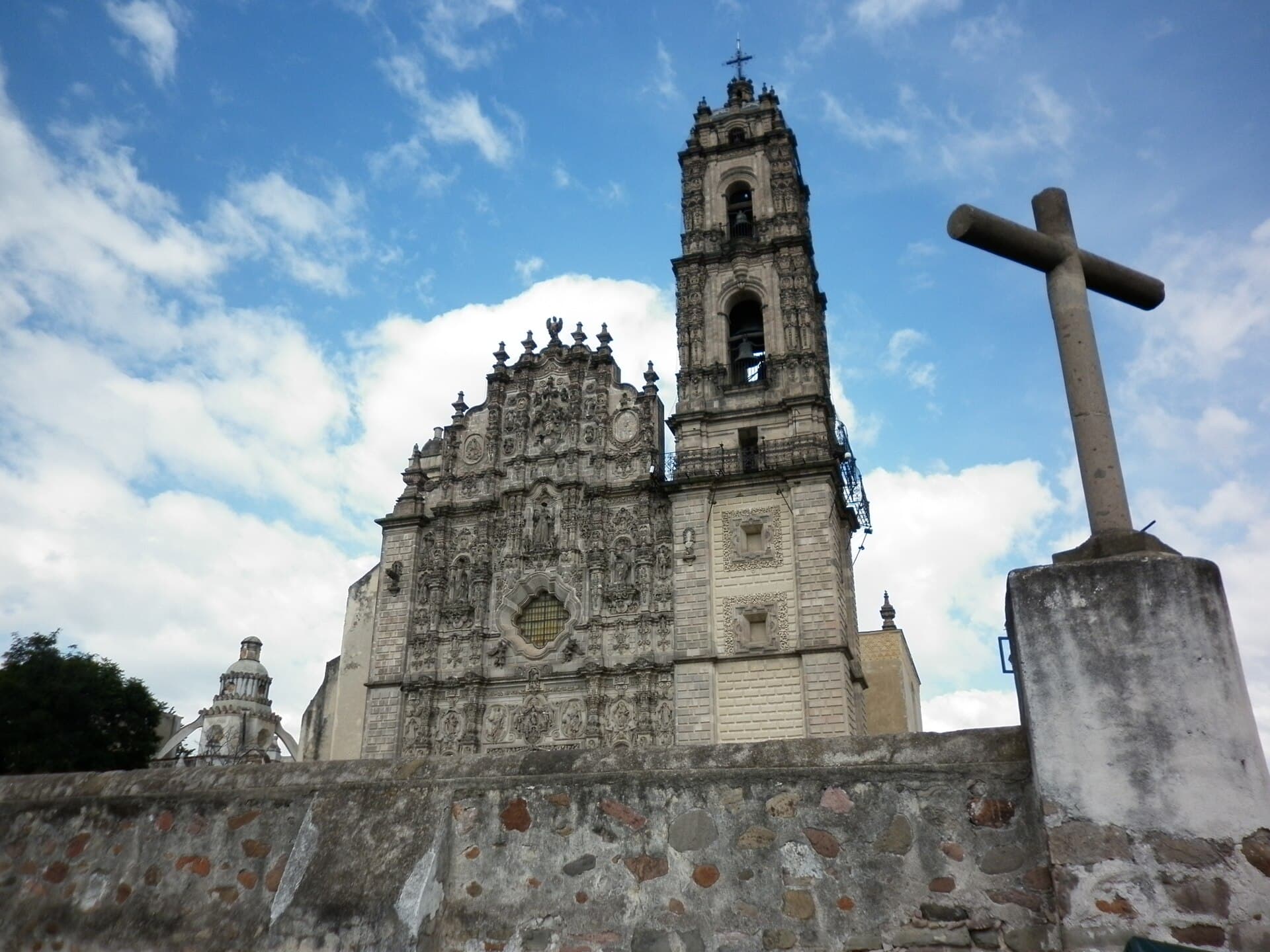
The 18th century marked an architectural golden age for Tepotzotlán, culminating in the construction of the magnificent facade and interiors of the Church of San Francisco Javier. Built between 1670 and 1682, with the facade and tower completed between 1760 and 1762 by architect Ildefonso de Iniesta Bejarano y Durán, this church stands as a globally recognized masterpiece of Churrigueresque, or Ultra-Baroque, art. Its gray stone exterior and interiors adorned with lavish gilded wooden altarpieces became the visual emblems of Tepotzotlán.
However, the flourishing Jesuit era abruptly ended in 1767 when King Charles III expelled the order from all Spanish territories. The college complex was subsequently transferred to diocesan clergy and later used to train new priests, house retired ones, and even as a place for priests who had 'committed some kind of error.' The impressive Arcos del Sitio Aqueduct, begun by the Jesuits in the early 1700s to bring water from the Oro River to their haciendas, was also left unfinished due to their expulsion.
Modern Recognition and Preservation
In 1933, the former Jesuit novitiate was declared a National Monument, and after extensive restoration between 1960 and 1964, it reopened as the National Museum of the Viceroyalty. Today, the museum holds one of Mexico's most significant collections of colonial-era art and artifacts. Tepotzotlán's historical and cultural importance has been recognized with its designation as a Pueblo Mágico (Magical Town) by Mexico's tourism department. In 2010, the former Jesuit complex was further honored by UNESCO as one of 60 sites along the Camino Real de Tierra Adentro, the historic 'Silver Route' that stretched from Mexico City to present-day New Mexico, USA.
The primary attraction in Tepotzotlán is undeniably the Museo Nacional del Virreinato (National Museum of the Viceroyalty), housed within the magnificent former Jesuit College of San Francisco Javier. This expansive complex is a repository of colonial art and history, featuring inner courtyards, fountains, and three hectares of gardens. The museum's collection includes liturgical pieces, non-religious everyday items, silverware, textiles, and tools from the colonial period.
Integral to the museum complex is the Church of San Francisco Javier, an awe-inspiring example of Mexican Churrigueresque Baroque architecture. Its elaborately carved gray stone facade and opulent interior, decorated with gilded wooden altarpieces by masters like Miguel Cabrera and Higinio de Chávez, are truly remarkable. Do not overlook the Domestic Chapel, a smaller, exquisitely decorated space once reserved for the college's members, and the Camarín de Loreto, a beautiful chapel dedicated to the Virgin Mary.
Outside the town center, the Arcos del Sitio Aqueduct (Xalpa Aqueduct) stands as an impressive feat of colonial-era engineering. This monumental aqueduct, the highest in Latin America, spans a deep gorge with four levels of arches, reaching 61 meters (200 feet) in height. The surrounding area offers a pleasant park where you can stroll across the aqueduct, enjoy picnics, or even try zip-lining.
Back in town, explore Tepotzotlán's large and beautiful Zócalo (main square), a central point surrounded by restaurants, bars, and the town and artisan markets. Here, you can discover local handicrafts, homemade food, and traditional Mexican sweets.
Tepotzotlán enjoys a pleasant temperate climate throughout the year, making it an inviting destination in any season. The dry season, from November to April, is generally considered the optimal time for outdoor activities, with clear, rainless days and comfortable temperatures ranging from 65°F to 80°F (18°C to 27°C). The peak tourism score is typically in the second week of May. While the rainy season extends from May to October, showers are usually brief and occur in the late afternoon or evening, leaving ample time for daytime exploration. Spring (March to May) offers delightful weather for exploring the town and attending local festivals.
Tepotzotlán is situated approximately 40-50 kilometers (25-30 miles) northwest of Mexico City, an easy one-hour drive. You can arrange a taxi or Uber, or take a bus from Mexico City's Terminal del Norte. Buses operate regularly, and the journey takes about an hour to 1.5 hours. Once in Tepotzotlán, walking and taxis are the best ways to navigate. If visiting the Arcos del Sitio, be aware that it is about 30km from the town center, and roads can be uneven. Public transport to the aqueduct can be infrequent, so a taxi or ride-share may be necessary.
Accommodation options include charming local hotels like Posada del Fraile. For dining, the municipal market provides excellent traditional dishes, drinks, and sweets. The town is generally considered secure for tourists, but standard precautions should always be observed.
- What is Tepotzotlán known for?
- Tepotzotlán is celebrated for its magnificent Churrigueresque Baroque architecture, particularly the Church of San Francisco Javier, and the National Museum of the Viceroyalty, which houses a significant collection of colonial-era art. It is also recognized for the monumental Arcos del Sitio Aqueduct.
- Is Tepotzotlán the same as Tepoztlán?
- No, Tepotzotlán and Tepoztlán are two distinct Pueblos Mágicos. Tepotzotlán is located north of Mexico City in the State of Mexico, known for its colonial architecture. Tepoztlán is south of Mexico City in Morelos, known for its mystical aura and its connection to the birthplace of Quetzalcoatl.
- How far is Tepotzotlán from Mexico City?
- Tepotzotlán is approximately 40-50 kilometers (25-30 miles) northwest of Mexico City, typically an hour's drive depending on traffic.
- What can I do at the Arcos del Sitio Aqueduct?
- At the Arcos del Sitio Aqueduct, you can walk across the monumental structure, enjoy picnics in the surrounding park, and even find opportunities for zip-lining.
- What kind of food should I try in Tepotzotlán?
- Be sure to try local dishes such as barbacoa (slow-cooked lamb), mixiotes (meat steamed in maguey leaves), and traditional Mexican sweets like alegrías (amaranth candy). The municipal market is an excellent place for authentic local cuisine.
- Is Tepotzotlán a UNESCO World Heritage site?
- Yes, the former Jesuit complex in Tepotzotlán, which includes the National Museum of the Viceroyalty and the Church of San Francisco Javier, is part of the UNESCO World Heritage designation for the Camino Real de Tierra Adentro.